
Echoes of an Enigma: Vermeer’s Girl with a Pearl Earring
Dive into the mystery of one of the most fascinating portraits in Dutch art, and rediscover Vermeer’s genius through his well-guarded secrets.
Faluns Of Anjou Arts
Immerse yourself in the artistic enigma that is Girl with a Pearl Earring
by Johannes Vermeer, a captivating painting that transcends time and cultures. Known as the Mona Lisa of the North, this work represents much more than a simple portrait, thanks to its mysterious beauty and subtle exoticism. Through the nuances of its history, let us together uncover the essence of a painter of intimacy, whose technique and color reveal an unexpected emotional depth. This exploration will also lead us on the tracks of Vermeer’s rediscovery, an artist who, after being forgotten, is today celebrated as one of the masters of Dutch painting.
How does Girl with a Pearl Earring illustrate Vermeer’s artistic mastery through the prism of exoticism, the expression of intimacy, and what has been the impact of its rediscovery on the perception of his work in art history?
I. Unraveling the Imaginary Exoticism and the Enigmatic Figure’s Fascination.
Previously known as the Girl with a Turban, this anonymous portrait has been compared to some works of Leonardo da Vinci, earning it the nickname Mona Lisa of the North for its beauty and enigmatic expression. The figure of the young girl emerges from a dark background, captured in profile with her gaze turned towards the viewer. Dressed in a yellow jacket with a white collar and adorned with a turban, she is decorated with a pearl earring, her face half-open as if about to speak, though she appears lost in thought. The triangular composition and side lighting accentuate the shadows on her face and garment, highlighting the pearl. The identity of the young woman remains a mystery, suggesting that the work represents not so much a specific individual as an idealized vision of exoticism. It belongs to the “tronies,” stylized portraits of imaginary figures in foreign costumes, popularized around 1630 and later imitated by Fragonard.
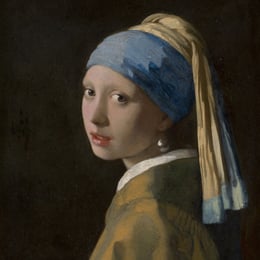

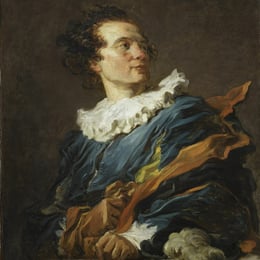
1. Girl with a Pearl Earring 2. Genre of tronies 3. Fantasy Figure. Portrait of the
Abbot of Saint-Non. Fragonard
II. Delving into Vermeer’s Intimate World and His Distinctive Pictorial Technique
The life and work of Vermeer, born in Delft, remain shrouded in mystery. Coming from a Protestant father, Vermeer converted to Catholicism to marry Catharina Bowles, from a wealthy family. A member of the Saint Luke’s guild from 1653, he was elected its head at the age of 30.
Despite producing only about three paintings a year, Vermeer quickly moved away from historical painting to focus on genre scenes capturing everyday life with remarkable poetry and discretion, often incorporating symbolic elements and allusions to love. His paintings, contemplative and dotted with everyday objects with hidden meanings, invite reflection rather than mere observation.
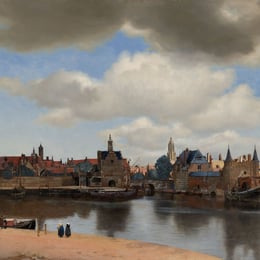
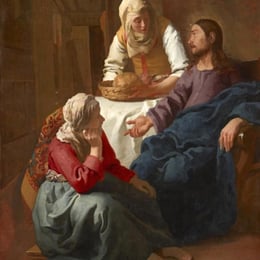
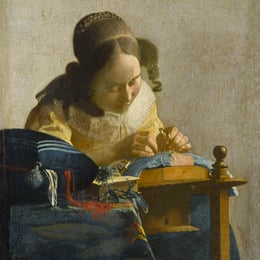
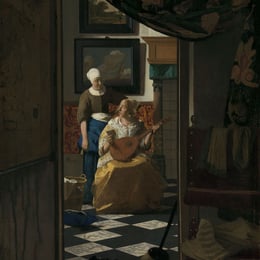
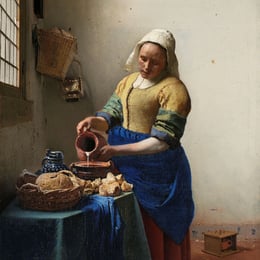
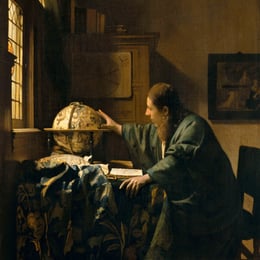
View of Delft
Johannes Vermeer Christ in the House of Martha and Mary About 1654 - 1656
Genre painting, On small formats
In his techniques, Vermeer favors light backgrounds to enhance his subjects, but in The Girl with the Pearl Earring, the dark background accentuates the luminosity of the model’s skin, evoking the influence of Leonardo da Vinci. Mainly using ultramarine blue and lemon yellow, he applies colors in successive layers to enrich his compositions with intense chiaroscuro, reminiscent of the Caravaggisti. Vermeer leaves no preparatory sketches; his works, often small square formats, suggest the use of the camera obscura to achieve images of remarkable precision and clarity, with the pearl thus becoming the captivating focal point for the viewer.
Ultramarine: A very expensive blue pigment made from lapis lazuli, imported from the Near East and Afghanistan.
Chiaroscuro: The distribution of shadow and light in a painting, in such a way that the darkest colors are juxtaposed with the lightest ones to produce a strong contrast effect.
The works of Leonardo da Vinci
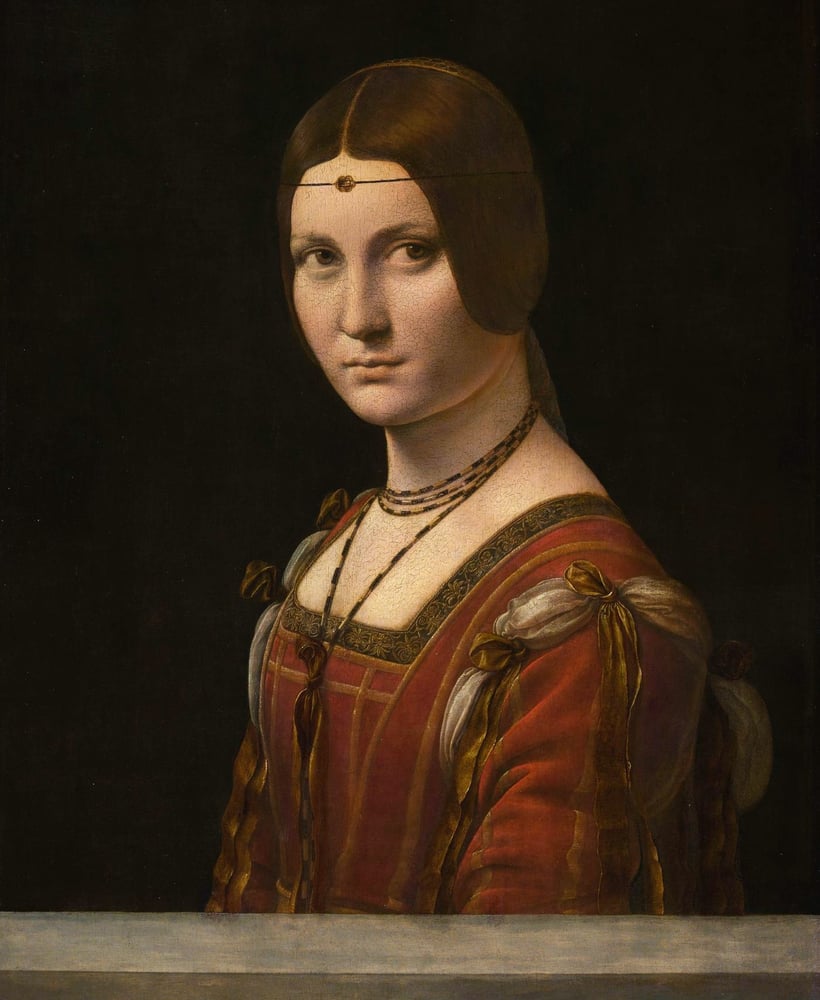
III. THE REDISCOVERY OF VERMEER: Tracing Vermeer’s journey from obscurity to his celebration as an icon of Dutch art
Known only in Delft and dying in poverty at the age of 43, Vermeer quickly faded into obscurity. His rediscovery began in 1696 when a public sale of twenty-one of his paintings sparked laudatory comments and high prices. In 1822, the Mauritshuis in The Hague acquired the View of Delft for a significant sum, marking a key milestone in the reevaluation of his work. In 1866, Thoré Bürger compiled a catalogue of seventy-two works attributed to Vermeer, contributing to his posthumous fame.
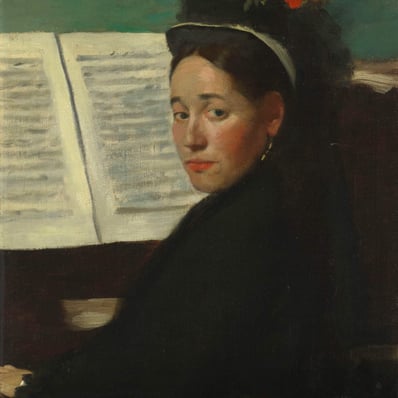
Edgar Degas, among other artists of the time, drew inspiration from Vermeer. Over time, the corpus of works attributed to Vermeer shrank, with some paintings reassigned to other artists. Vermeer’s fame also encouraged the emergence of forgers.
The novel Girl with a Pearl Earring by Tracy Chevalier, published in France in 2000 and inspired by the famous painting, imagines a fictional story about the model, presented as a servant in the Vermeer household. The film adaptation of the novel greatly popularized Vermeer among the general public, offering a new perspective on his life and work.
Edgar Degas, among other artists, was inspired by the master.
Vermeer’s Girl with a Pearl Earring embodies a perfect synthesis of exotic beauty, technical mastery, and emotional depth, offering a window into the soul of the painter and his era. Its rediscovery has not only enriched our understanding of 17th-century Dutch art but has also affirmed Vermeer’s genius as a timeless visual storyteller.
Vermeer’s work, especially Girl with a Pearl Earring, continues to fascinate and inspire, demonstrating the art’s ability to capture the essence of humanity and transcend centuries. Its rediscovery reaffirms the importance of preserving and celebrating our cultural heritage for future generations.
Join us in this artistic odyssey by exploring more of Vermeer’s universe and the richness of Dutch art. Subscribe to our YouTube channel to discover other hidden treasures of art history.
#Vermeer #GirlWithAPearlEarring #ExoticBeauty #PainterOfIntimacy #RediscoveryOfVermeer #DutchArt #ArtisticTreasures
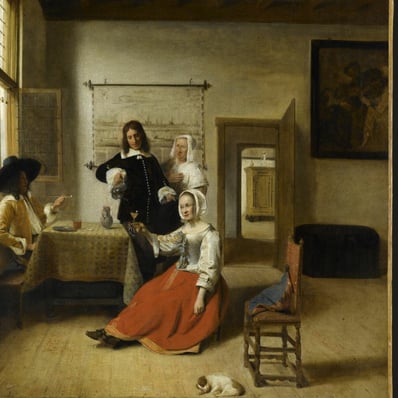
Love references are constant
The painter values domestic activities
Intellectual activities
The Drinker, 1652 / 1661 (Mid-17th century), Hooch, Pieter de Netherlands
