
Echoes of the Past: A Journey through French Art
From the Luminous Renaissance to the Dynamism of Cubism: Rediscovering the Jewels of French Artistic History
Faluns Of Anjou Arts
Dive into the advent of Cubism, an aesthetic revolution initiated by Georges Braque and Pablo Picasso that radically transformed the concept of painting and space in art. Explore how these pioneers dismantled traditional perspective to reassemble reality into geometric forms, thus introducing a radically new visual language at the beginning of the 20th century.
How has Cubism, through the works of Braque and Picasso, challenged the foundations of representation in painting, and what impact has this movement had on the evolution of modern art?
I. The Elusive Representation by Picasso: The Challenge of Visibility and Intelligibility in Modern Art
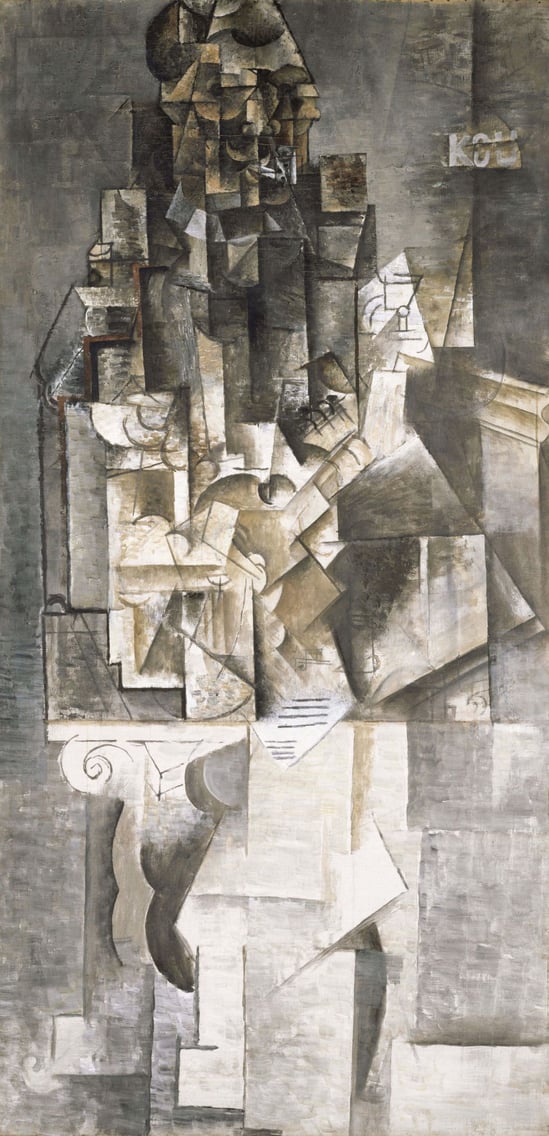
Initiated in the techniques of traditional painting, Pablo Picasso broke away abruptly with the creation of Les Demoiselles d’Avignon in 1907, a major work now in the United States. This act marked his entry into the Cubist revolution. His painting The Guitarist, which he kept in his own collection for a long time, provides insight into his experiments within this pioneering movement of contemporary art.
IN SEARCH OF THE LOST GUITAR
Picasso often returns to the musical motif in his works. The Guitarist is one of eight major Cubist works that depict male or female characters with instruments.
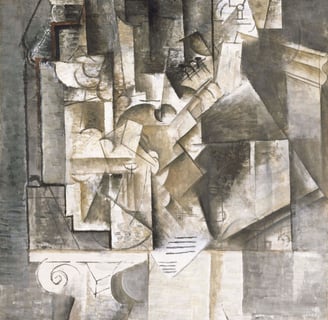
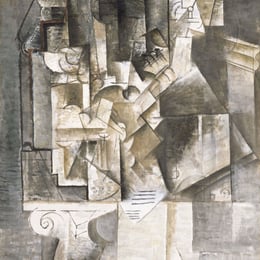
Faced with this large canvas, the viewer confronts a network of geometric shapes and a palette of subdued colors made up of browns, ochers, and grays. The overall impression is one of fragmented light. Certain elements serve as clues to guide observation: the letters KOU and some objects. A sketched pipe allows locating the mouth, the starting point to outline the face. The base and top of a glass suggest the presence of a table on the right. And it’s through the white paper of a score that one can discern the dark opening of the guitar, thus locating the body and neck of the instrument. The audience is thus invited to actively participate in the recomposition of the scene, decomposed and analyzed by the artist, culminating in the figure of a guitarist, pipe in mouth, seated at a cafe table.
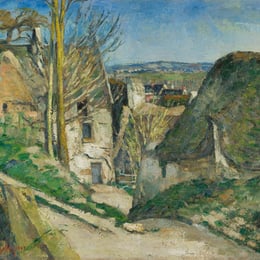
Cubism is an artistic revolution that emerges just before World War I, with Pablo Picasso and Georges Braque as its leading figures. This movement proposes a renewed vision of the object, expressing its forms and perspectives in a stylized and multidimensional way, often from multiple viewpoints simultaneously. It draws its influences from the structural explorations of Paul Cézanne as well as from primitive art.
The Man with a Guitar, Autumn 1911 Paris
Why is the representation in Picasso’s art complicated? The artist questions one of the fundamental challenges of painting: how to render a three-dimensional subject on a two-dimensional canvas. Moving away from traditional techniques of perspective and volume to depict space, Picasso instead seeks a merger between the subject and its background. He is influenced by Cézanne’s experiments, who breaks down forms into geometric blocks and uses parallel brush strokes to blend neighboring planes. In his analysis, Picasso deconstructs each element separately, leading him to fragment reality. He incorporates both subject and background into a unified network of geometric lines and abandons color, finding it too emotional. However, this analytical Cubism of the 1910-1911 years risks making the artwork indecipherable, as the geometrization threatens to turn into abstraction.
Modeling: The method of rendering the relief of forms, especially those of the human body.
Perspective: A technique used to represent space and objects with depth and volume on a flat surface to give the illusion of the third dimension.
Abstract Art: An artistic expression that emerged in the early 20th century and does not involve the representation of reality. Kandinsky (1866-1944) is a pioneering artist of this new trend in painting. Various movements of abstract art have succeeded or coexisted to the present day.
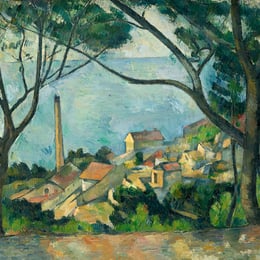
1 - The Sea at L’Estaque Work by Paul Cézanne (1839-1906)Oil on canvas
2 - Paul Cézanne, The Hanged Man’s House, Auvers-sur-Oise 1873 oil on canvas
3 - The Man with a Guitar, Autumn 1911 Paris
II. Picasso and Braque’s Cubism: Painting in Search of a New Dimension of Artistic Expression.
Picasso and Braque’s Cubism: A Pictorial Exploration
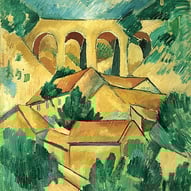
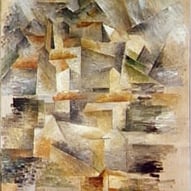
Between 1908 and 1914, Picasso and Braque embarked on an intense collaboration, likened to mountaineering, where each advancement by one provoked a response from the other. Sharing their creative space and even forgoing the signing of their works, they cultivated an artistic synergy. Their paintings, whether of characters, landscapes, or still lifes, display such harmony that it becomes difficult to identify the creator of each piece.
The term cubism, stemming from Matisse’s comment describing a landscape by Braque as made of “little cubes,” was quickly embraced by critics. Picasso and Braque emerged as leading figures of this revolutionary art movement. Guillaume Apollinaire’s support was unequivocal; in his 1913 book “Les Peintres cubistes,” he championed the freedom to paint with any material, valuing the inherent worth of the work.
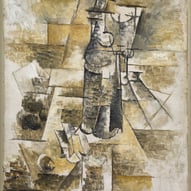
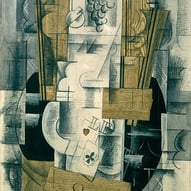
1 - Georges Braque, Still Life with Bottle, 1910 - 1911, Oil on canvas, 55 x 46 cm
2 - Georges Braque, The Viaduct at L’Estaque, 1908, Paris Oil on canvas, 72.5 x 59 cm
3 - Georges Braque, The Rio Tinto Factories at L’Estaque, Autumn 1910 Former titles: The Factories of L’Estaque; Landscape of L’Estaque; Houses of Rio Tinto Oil on canvas, 65 x 54 cm
4 - Georges Braque, Fruit Bowl and Cards, Early 1913, Paris Former titles: Composition with the Ace of Clubs; Still Life with Playing Cards; Still Life with a Deck of Cards; The Two Playing Cards Oil, highlighted with pencil and charcoal on canvas, 81 x 60 cm
Picasso’s Artistic Explorations in The Man with the Guitar
Picasso’s “The Man with the Guitar,” a canvas bearing the marks of three consecutive years - 1911, 1912, 1913, reveals the painter’s laborious and experimental approach, encapsulated in his statement, “I do not seek, I find.” Each phase of the painting signifies a new experiment, a continuous quest for creation.
The central part of the painting, with its fragmentation into geometric planes, illustrates analytical cubism. However, the lower section of the painting transitions to synthetic cubism, where Picasso reintroduces more recognizable forms to prevent total abstraction.
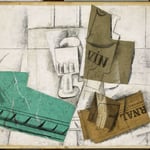
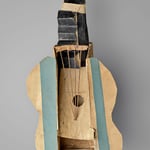
This trend towards reaffirming realism leads him to new experiments, such as the incorporation of non-traditional materials in his works, exemplified in “Still Life with Chair Caning.” He also experiments with sculpture, using cardboard, string, and sheet metal to explore three-dimensionality. Cubism, for Picasso, thus becomes a period of intense and varied exploration in the field of painting.
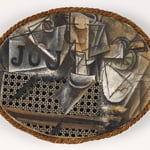
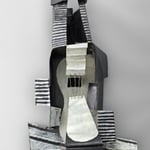
1 - Pablo Picasso, Still Life with Chair Caning, Spring 1912, Oil on canvas
2 - Pablo Picasso, Glass, Wine Bottle, Tobacco Package, Newspaper, March 1914, Watercolor, pencil drawing, charcoal, newspaper pape
3 - Pablo Picasso, Guitar, assemblage of cardboard, string, sheet metal
4 - Pablo Picasso, Guitar, 1924, Assemblage, tinplate, wire, sheet metal
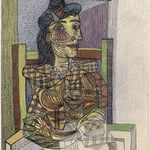
5 - Pablo Picasso, Dora Maar Seated, February 2, 1938, Cardboard, India ink, pencil lead, pastel
Cubism, initiated by Braque and Picasso, marked a fundamental break from traditional art. By fragmenting objects and abandoning a single perspective, they reinvented how to represent the world on canvas, paving the way for a myriad of visual and conceptual perspectives.
The cubist works of Braque and Picasso remain a testament to their relentless quest for innovation. Their boldness not only redefined painting conventions but also laid the groundwork for the many artistic advancements of the 20th century.
Join us to explore the disruptive universe of Braque and Picasso and discover how Cubism continues to influence contemporary artists. Immerse yourself in this artistic saga that has forever changed the landscape of modern art.
#Cubism #Picasso #GeorgesBraque #ArtisticRevolution #ModernPainting #CubistInnovation #20thCenturyArt
