
From Ancient Coinage to Classical Canvas: A Journey Through French Art History
Unearth the hidden gems of French art, from ancient Gaulish coins etched with history to the brilliance of classical canvases. Join us on an artistic odyssey that transcends time and unveils the soul of a nation.
Faluns of Anjou Arts
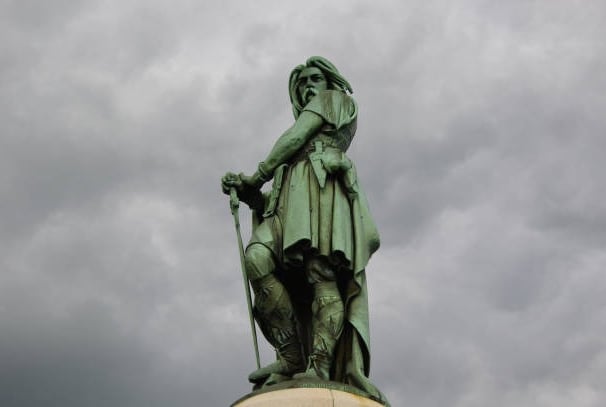
Historical Context
Gaul, encompassing present-day France and extending to the Rhine, also included parts of what are now Belgium, Luxembourg, Netherlands, Germany, and Switzerland. Initially home to indigenous peoples such as the Iberians and Arverni, it was later settled by Celts. By the mid-1st century BC, Rome, under Julius Caesar, conquered Gaul following Vercingétorix's defeat at Alesia in 52 BC, marking the start of Roman Gaul and Gallo-Roman art. Following Rome's fall, Christianity played a pivotal role in maintaining state structures. In 496, Clovis, a Frankish king, converted to Christianity, uniting Gaul under Merovingian rule.
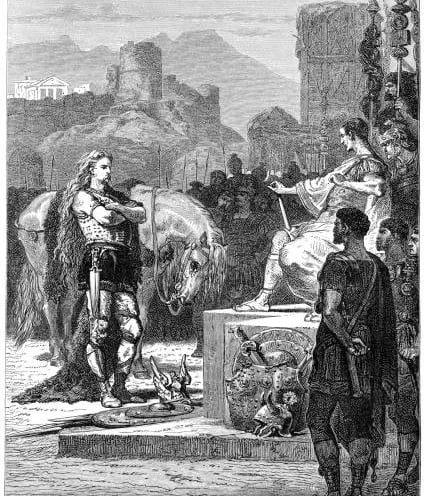
Vercingetorix statue
Vercingetorix, the Gallic leader who opposed Caesar.
The emergence of coinage in the Mediterranean regions of Gaul is credited to the influence of Greek colonies such as Marseille from the 6th century BC. With the initiation of minting their own coins in the 3rd century BC, the Gauls began by replicating Macedonian gold staters, before swiftly developing a unique style adorned with Celtic symbols. Later, in the 2nd century BC, Gaulish coins began to align with the Roman denarius, reflecting their increasing integration into the economy and culture of Rome, the dominant power of the era.
To what extent do Gaulish monetary representations, such as the gold stater from Pionsat, illustrate the cultural influences and artistic choices of Gaul during Vercingetorix's time?
I. Vercingetorix's Stater: A Currency of Power and a Symbol of Resistance
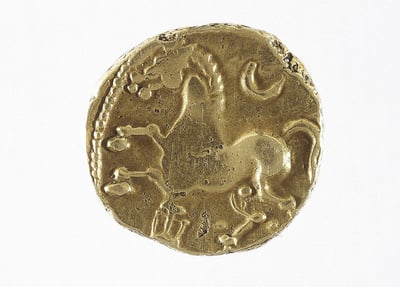
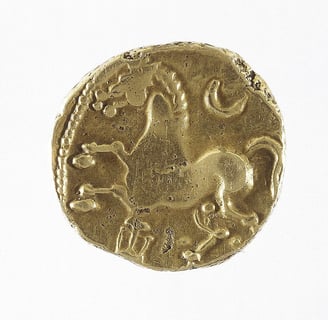
The gold stater found in Pionsat in 1852, in the Arvernian region, stands as a hallmark of Gaulish coinage. Mirroring the dimensions and weight of Macedonian staters, it features a male portrait reminiscent of King Philip's royal profiles, with fine features and distinctive hair. Its reverse depicts a Gaulish horse jumping an element resembling an amphora, and the truncated inscription suggests the name Vercingetorix. This renowned Gaulish leader, primarily known through Caesar's writings, is portrayed in texts as a young and formidable military leader. The scarce coins bearing his name, likely issued during the Gallic War, are today regarded as symbolic representations rather than actual portraits, possibly of a deity like Apollo rather than Vercingetorix himself.
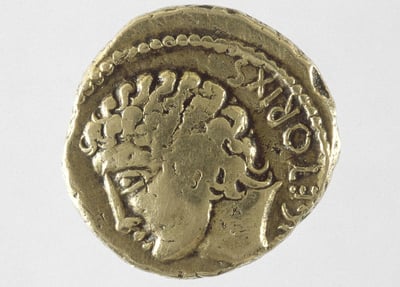
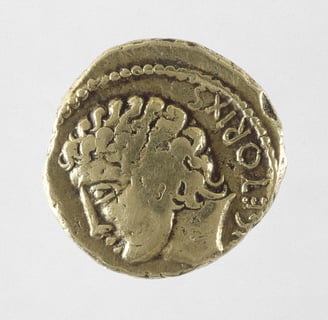
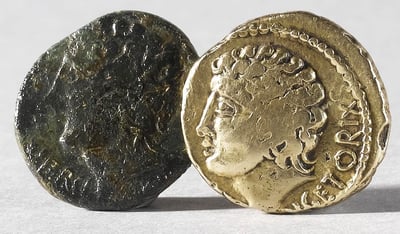
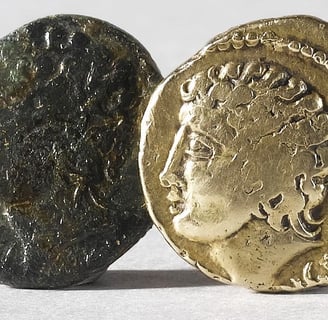
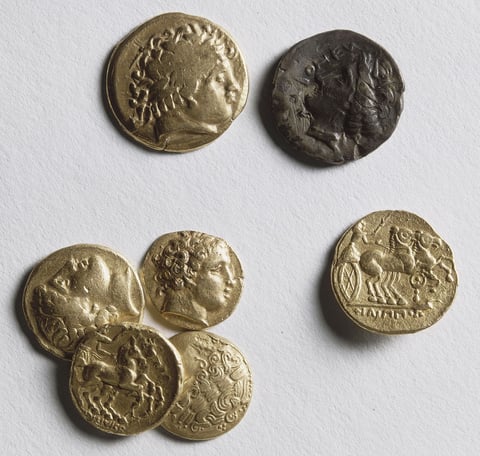
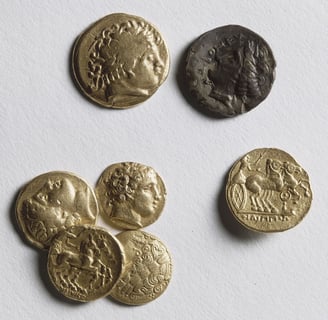
VERCINGETORIX STATERE Obverse features a male portrait reminiscent of the royal profiles of Philip
STATERS OF PHILIP II OF MACEDON
Philip II, ruler of Macedonia from 359 to 336 BC, laid the groundwork for the territorial expansion that his son, Alexander the Great, would continue. Under his rule, Macedonia asserted its dominance over a significant part of Greece. In 1977, his tomb was discovered in Vergina, revealing its remarkably preserved contents, rich in precious metalwork.
VERCINGETORIX STATERE Reverse depicts a small Gallic stallion topped with a crescent moon.
VERCINGETORIX COINS in bronze and gold stater.
French art, richly diverse and historically significant, offers insight into cultural and political evolutions across ages. From the introduction of coinage in Gaul, which bears witness to Mediterranean interactions and Roman assimilation, each coin reveals a slice of history. The monetary representations of Vercingetorix, though rare and idealized, bring us closer to the narratives and personas of ancient Gaul. French art is an ongoing dialogue between past and present, reflecting the values and ideals of each era.
The journey through French art is an exploration of the identity and spirit of a nation. From the earliest Gaulish coins to the delicate canvases of the classical era, each piece invites us to rediscover forgotten narratives and celebrate France’s artistic legacy. These artifacts are not just witnesses to their time; they are the silent narrators of complex and enriching stories that continue to inspire and educate.
Dive into the saga of French art with our blog “Chronicle of French Art”. Subscribe to uncover the secrets of past masters and to enrich your understanding of the cultural heritage that has shaped modern art. Share your own interpretations and be inspired by the richness of French artistic history.
#FrenchArt, #CulturalHeritage, #GaulishCoins, #PierreAntoineLemoine, #HistoryOfFrance, #ArtClassics, #Vercingetorix
