
Insights on the Field: Jules Bastien-Lepage and the Revolution of Rural Realism
Diving into the Soul of 19th Century French Countryside: An Artistic Odyssey
Faluns of Anjou Arts
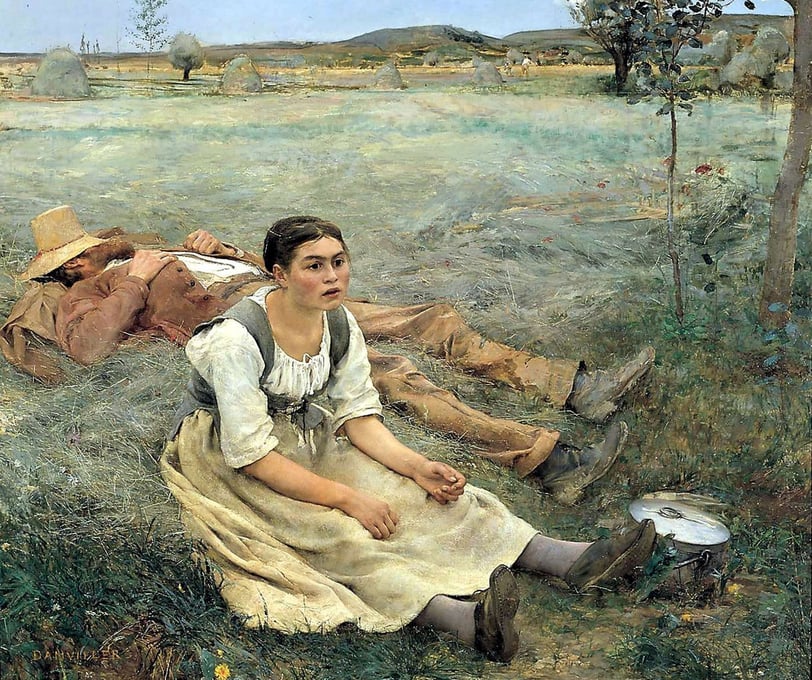
In the 19th century, realism in France found one of its most striking expressions through Jules Bastien-Lepage, particularly with his iconic work, Les Foins. This painting captures rural life with remarkable precision, highlighting the labor and daily lives of peasants. Bastien-Lepage, by choosing the rural world as his model, does not merely depict reality in a raw form; he prompts a profound reflection on the evolution of peasant world representation, thus breaking away from earlier idealizations. Bastien-Lepage’s approach, rooted in meticulous observation, signifies a significant shift in 19th-century art, where realism becomes a means to explore and convey the social and human conditions of the time.
How does Jules Bastien-Lepage’s, Les Foins reflect the evolution of rural world representation and peasant realities in 19th-century realist art, and what impact has this approach had on the perception of rurality and peasant labor?
I. From Idealization to Reality: The New Representation of Peasants in 19th Century Art
As we examine the rural scene titled,Les Foins, a flagship work by Jules Bastien-Lepage, we encounter an artist with a decade’s painting experience. Hailing from Lorraine, he moved to Paris in 1867 and the following year joined the studio of the prominent academic teacher Alexandre Cabanel. Initially dedicating his talent to historical subjects and portraits of distinguished individuals, which brought him recognition, he gradually moved away from these themes to embrace one closer and dearer to him: rural life.
Les Foins:The Haystacks
Portraits of notables
A POEM AS A MUSE
The inspiration behind this painting stems from a poem by André Theuriet, a friend of Bastien-Lepage, whose mother also shares Lorrainian roots with the artist. Theuriet, an ardent nature lover, often celebrates it in his writings with great lyricism. These poetic lines inspired the painter to create a scene depicting a peasant couple, capturing the beauty of rest after labor in a welcoming natural environment:
Noon!… The light bathes the mown fields.
On a mound of fresh grass, his makeshift bed,
The mower rests, gripping his fists tightly.
Seated beside him, a sun-kissed haymaker
Gets lost in her thoughts, eyes wide open, intoxicated
By the enchanting fragrance emanating from the hay.
THE RURAL AS MUSE
In his artistic endeavor to capture the essence of peasant life, Bastien-Lepage naturally looks to his hometown of Damvillers, just as Gustave Courbet captured the residents of his own town in the realist work “A Burial at Ornans” from 1850. He chooses familiar faces for his subjects: his grandfather for the role of the reclining mower and a cousin to embody the weary young peasant woman.
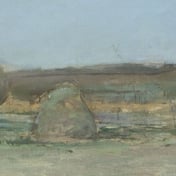
Bastien-Lepage’s compositional choice favors an intimate setting that focuses on the figures by raising the horizon line, thus emphasizing the characters over the cut hay in the background, which gives the painting its name.
He employs a dual approach in his technique: one detailed and precise, depicting the traits, expressions, and clothing of the characters, and the other more suggestive, capturing the atmosphere of the day and outlining the distant landscape.
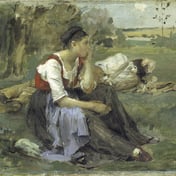
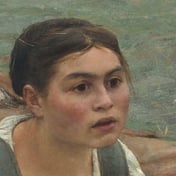
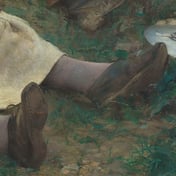
An initial sketch reveals a significantly different original composition, later refined by the artist for a more truthful depiction. The young woman is ultimately portrayed in three-quarter view, her tired expression and vacant gaze conveying exhaustion. Seated on the grass, her back is bent, with arms and hands resting lifelessly on her skirt’s coarse fabric, and legs apart in an unpretentious pose. Far from posing, she does not attempt to beautify her hard condition. Her shoes, described with almost photographic realism, display the mud covering them, unflinchingly highlighting the ruggedness of peasant life.
Behind her, the man rests, his face shielded by his straw hat, signifying a moment of respite and escape from the daily toil and the world around him. It’s a break in time, a fleeting moment of forgetfulness and rest.
Composition: The method of arranging figures, motifs, or colors in the creation of a work of art.
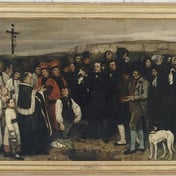
1- A Burial at Ornans
2- The horizon line at its highest
3- A small sketch
II.Impact and Legacy: The Significance of Bastien-Lepage’s Work in Understanding the Rural World
ACCLAIM AT THE SALON
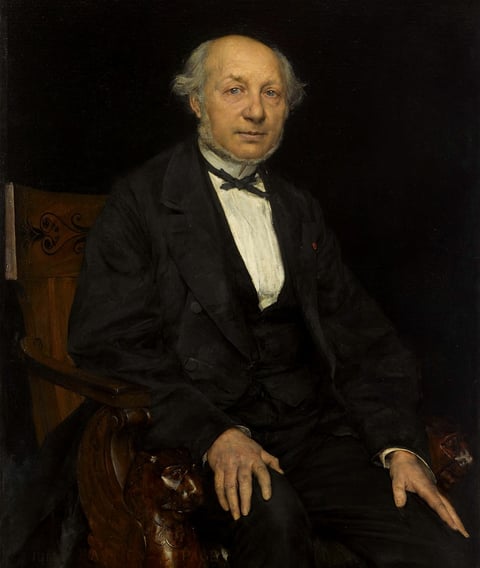
In 1878, Bastien-Lepage decided to present his vast depiction of peasant life (nearly 2 meters wide) at the Salon, accompanied by a portrait of André Theuriet. The critical reception was enthusiastic. Emile Zola, while recognizing his talent, nevertheless expressed a reservation about this warm reception, noting: All innovators have initially faced significant resistance, without exception. The fact that he is being applauded might be a bad sign.
Zola, who would later write, La Terre, a novel rooted in the agricultural world, sees in Bastien-Lepage’s work the very essence of what he aims to depict in literature. To him, Bastien-Lepage embodies the spirit of naturalism, a movement that aims to portray social reality without embellishment or idealization. The precision of detail and the truthfulness of postures make this painting a living testimony to the transitioning rural world.
This success secures the promising career of the young artist. Tragically, his life ends prematurely at the age of 36. In tribute, his friend Auguste Rodin, following a fundraising initiative started by the painter’s brother, creates a sculpture in his likeness for Damvillers, his hometown.
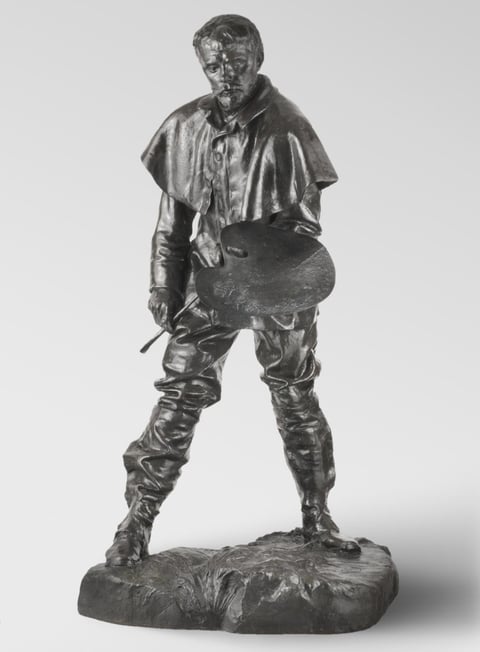
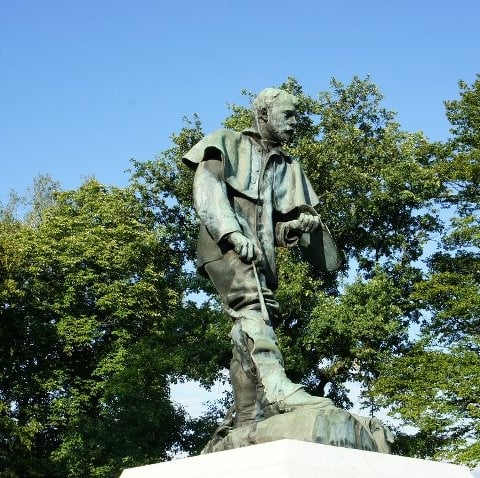
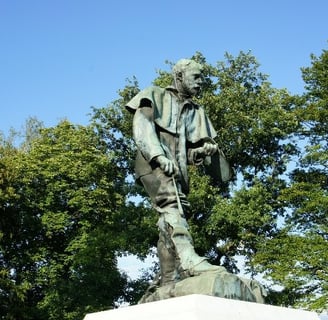
A sculpture in his likeness for his hometown, Damvillers.
The Evolution of Peasant Representation in Painting
From the 17th century with the Le Nain brothers to Vincent Van Gogh at the end of the 19th century, the peasant world has been a frequently depicted subject by artists. Although always in pursuit of realism, the representation in the 17th century is often idealized, concealing a symbolic message beyond simple peasant life.
In the 19th century, with artists like Bastien-Lepage, the focus shifts to an authentic portrayal of rural life. In 1866, Millet, in “The Angelus,” presents an image filled with respect for field workers, showing their deserved rest. Inspired by Millet, Vincent Van Gogh revisits this theme between 1889 and 1890, transforming the scene into a celebration of color, where the vivid yellow and blue veer away from any fidelity to reality.
In the midst of the upheaval of the 19th century, marked by the onset of industrialization and the persistence of a traditional way of life in the countryside, Bastien-Lepage chooses to depict peasants who are both weary and dignified, simple and perhaps naive, but embodying the noble task of cultivating the nourishing earth.
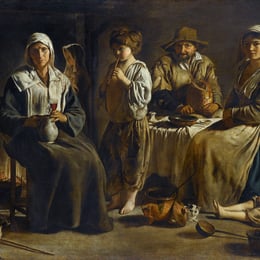
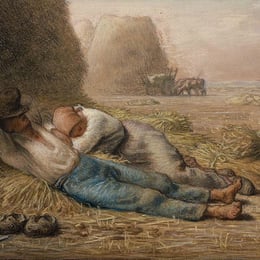
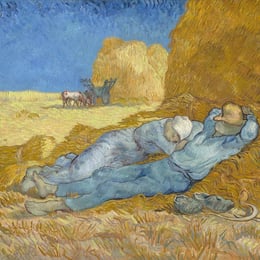
1 -Peasant Family in an Interior Three Brothers For One Studio: Antoine, Louis, and Mathieu Le Nain
2 - In 1866, in La Méridienne, Millet presents a respectful vision of these field workers, legitimately tired, resting side by side.
3 - Vincent Van Gogh draws inspiration from the image offered by his elder and, between 1889 and 1890, presents a renewed version.
The work of Jules Bastien-Lepage, especially, Les Foins, marks a turning point in 19th-century realistic art in France. By moving away from idealized representations of the rural world to embrace a more authentic approach grounded in the peasants’ lived experiences, Bastien-Lepage paves the way for a new perception of rural life. His ability to capture the harsh reality of agricultural work while paying tribute to the dignity and beauty inherent in country life offers a complex and nuanced vision that enriches the artistic discourse on the peasant world. This evolution in the representation of the rural world reflects a broader change in French society at the time, recognizing the value and importance of the peasant class in the country’s social and economic fabric.
Through Les Foins, Jules Bastien-Lepage embodies the spirit of realism by painting the rural world of the 19th century with sincerity and depth. His work constitutes not only a significant artistic advancement but also a valuable sociological document, capturing the essence of a changing era. By placing the peasant at the heart of his art, Bastien-Lepage contributes to reevaluating the rural world’s place in collective consciousness, offering a renewed perspective on the beauty and complexity of country life.
Discover the fascinating world of Jules Bastien-Lepage and dive into the heart of 19th-century realism. Explore the richness and depth of Les Foins to better understand the impact of art on our perception of the rural world. Join us on this artistic and cultural adventure to celebrate the legacy of a painter who captured the soul of the French countryside.
#JulesBastienLepage #LesFoins #19thCenturyRealism #RuralWorldArt #PeasantEvolution #ArtAndSociety #RuralHeritage
4- The young woman is finally presented in three-quarter view her face
5- Her worn shoes
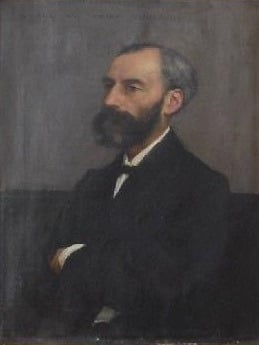
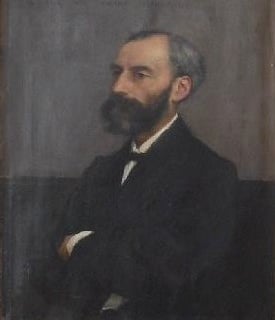
A portrait of André Theuriet
