
Mosaics in Light: Reflections of the Gallo-Roman Past
Explore the Rustic Calendar, a gem of ancient craftsmanship in Saint-Romain-en-Gal, and delve into the splendor of mosaics that have stood the test of time.
Faluns Of Anjou Arts
Ancient mosaics continue to fascinate and bear witness to the artistic refinement of past civilizations. The discovery of the Rustic Calendar mosaic in Saint-Romain-en-Gal is an outstanding example of this art, providing valuable insight into the practices and daily life of the Gallo-Roman era.
How does the Rustic Calendar mosaic in Saint-Romain-en-Gal illustrate the cultural and artistic interactions between the Gauls and Romans, and what light does it shed on rural life in antiquity?
Why is this mosaic called a calendar, and what does it teach us about the Gallo-Roman period?
Unearthed in 1891, the mosaic known as the Rustic Calendar came to light in Saint-Romain-en-Gal, a village on the banks of the Rhone, directly opposite the city of Vienne. It dates back to the period of rapid expansion and Romanization of Vienne, following its elevation to the status of a Roman colony by Augustus in the first century.
Mosaic: An art form that involves creating large decorative panels using a multitude of small cubes (tesserae) made from various materials (stone, ceramic, glass) and in various colors, arranged on a plaster. It is a favored decoration for the floors and walls of grand public buildings and wealthy homes.
I. Harmony of Seasons and Annual Labors: A Meticulous Illustration through the Rustic Calendar Mosaic.
A meticulously arranged mosaic on the seasons
Adorning the floor of a reception room in a villa, this mosaic originally consisted of forty panels framed by a braid design, but only twenty-seven of them have reached us. Each scene is carefully arranged around the four central panels, depicting the four seasons through the image of an old woman and young children: winter, wrapped in a blue cloak, is shown sitting on a boar; spring, adorned with greenery, mounted on a bull; summer, perched on a lion, wields a crown of golden wheat; and autumn, riding a panther, sports a basket of grapes on its head.
Villa: A term used in ancient Rome to refer to a country estate (villa rustica) or a wealthy residence near the city (villa suburbana).
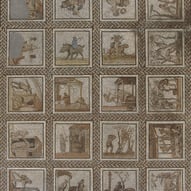
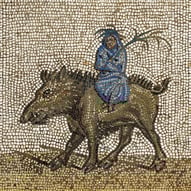
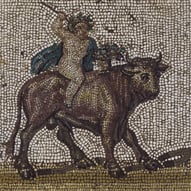
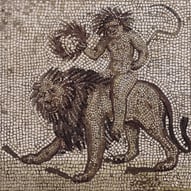
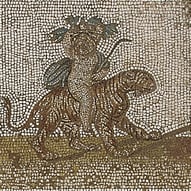
The mosaic that adorned the floor of a reception room in a villa
Depiction of the four seasons: winter, shivering and draped in a blue cloak, seated on a wild boar.
Spring, crowned with foliage, rides a bull.
Summer, seated on the back of a lion, holds a crown of ripe wheat.
Autumn, astride a panther, carries a basket of grapes on his head.
Nine distinct seasonal tasks
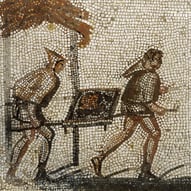
Each set of scenes portrays the seasonal tasks, both agricultural and ritual, marking each month of the season, hence the term calendar. Winter activities include sowing beans, transporting manure, and sacrifices to the lares, guardian deities of the home. Spring sees the arrival of storks. Summer is marked by sacrifices to the Gaulish god Taranis in anticipation of the harvests.
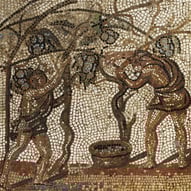
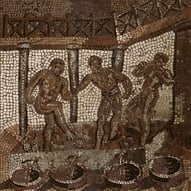
Autumn is the time for grape harvesting, grape treading, and olive picking. The predominance of agricultural activities justifies the adjective rustic for this type of calendar. The representation of certain tasks, such as olive picking, reflects a Roman influence, as the olive tree was not cultivated in the region of Vienne but typical of Mediterranean agriculture. In Vienne, oil was imported from Spain.
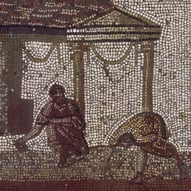
II. Part 2: Reflection of Romanization: Assimilation and Adaptation of Mosaic Art among the Gaulish Peoples.
A reflection of Roman acculturation
The mosaic technique itself is evidence of the deep acculturation of the Vienne region to Roman culture during the Gallo-Roman era. The adoption of this new lifestyle, especially evident in the architecture of urban houses like the domus and its decoration, signaled integration within the Roman Empire. The Rustic Calendar, from a villa in the residential area of Vienne, perfectly illustrates this transition.
Mosaics, favored by the Roman elite to adorn the floors and sometimes the walls of their villas, indicate the high social status of its owner. Although the Romans did not originally invent the mosaic, they greatly improved its technique and promoted its spread throughout the Empire. The theme of the seasons, central to the mosaic of Saint-Romain-en-Gal, is a recurring motif in Roman art, as evidenced by a later work preserved in the Louvre, originating from Antioch in Turkey, on the eastern edges of the empire.
Domus: The name given to a private house in ancient Rome.
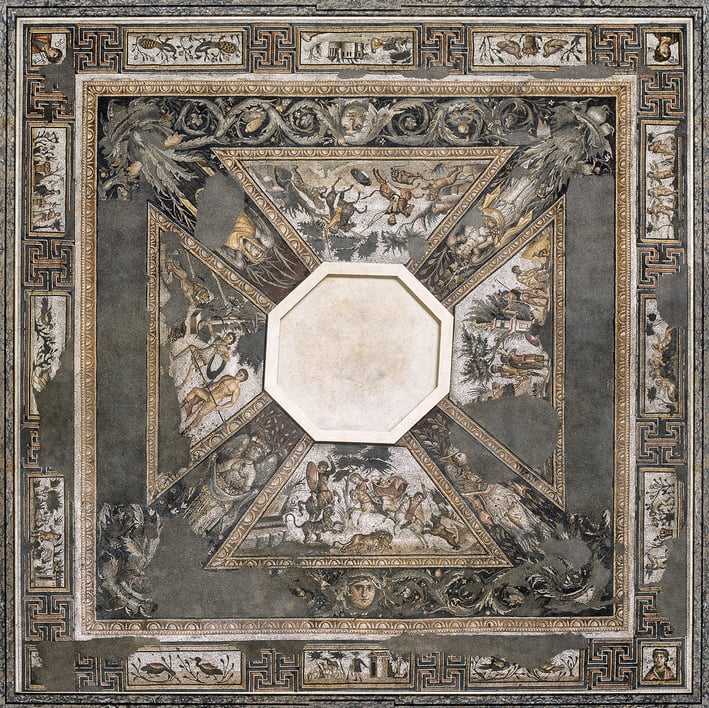
A later mosaic, preserved at the Louvre, originating from Antioch, Turkey, then on the eastern edges of the empire.
The Adoption and Adaptation of Mosaic Art by the Gauls
The mosaic found at Saint-Romain-en-Gal illustrates the capability of residents in Roman Gaul to incorporate and personalize an advanced artistic technique. Its uniqueness lies in elaborate polychromy, utilizing tesserae of various colors and shades to sculpt volumes and shapes. Figures are often realistically depicted, grounded by their cast shadows, highlighting the Viennois
mosaicists’ talent in developing a distinct provincial style while diverging from Greco-Roman naturalistic norms. For instance, the oversized grape clusters and stereotyped buildings reflect this originality. The work also reveals the presence of typically Gaulish garments, such as the cucullus, a hooded cape, underscoring a unique fusion of Roman influences and local traditions.Image 7 and 8
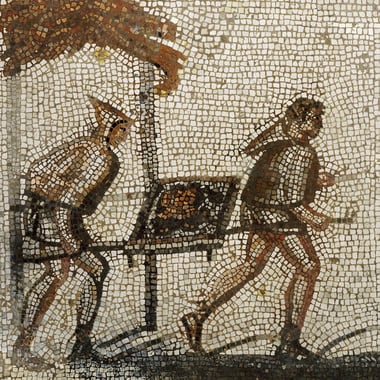
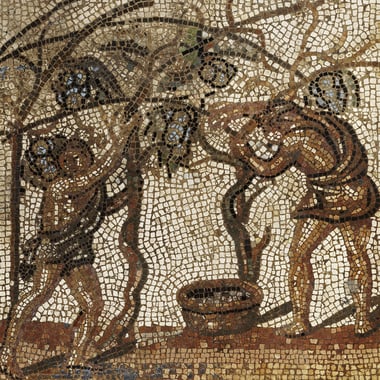
1. Manure is transported. 2. Autumn is the time for grape harvests.
The Rustic Calendar is more than just an art piece; it is a historical document that unveils the finesse of mosaic craftsmanship and the rich cultural symbiosis of the Gallo-Roman era.
Through its motifs and composition, The Rustic Calendar remains a privileged witness to the integration of Roman arts by the Gauls and their agrarian daily life.
Discover the richness of Gallo-Roman heritage through the Rustic Calendar mosaic and delve into the captivating history of ancient mosaics.
#RusticCalendar #AncientMosaic #SaintRomainEnGal #GalloRomanArt #HistoryOfMosaics #GaulishRomanization #AncientLife
In winter, beans are sown.
Manure is transported.
Autumn is the time for grape harvests.
This includes the pressing of grapes and the picking of olives.
