
Prehistoric Treasures of French Art
Dive into the mysterious origins of artistic creation at the heart of the Dordogne.
Faluns of Anjou Arts
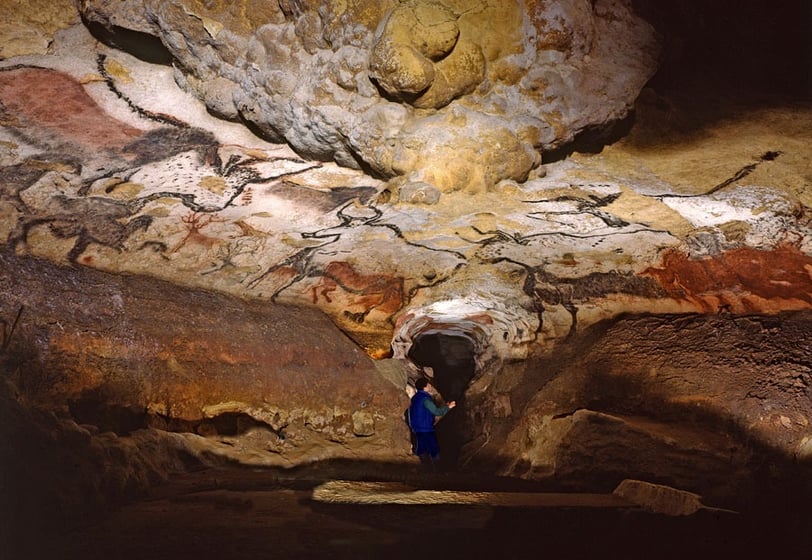
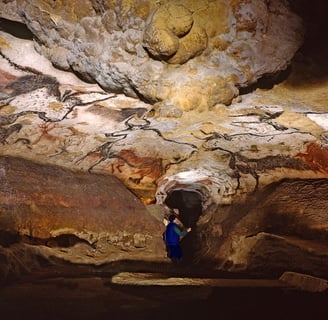
Entrance of the cave
Welcome to the mysterious depths of the Lascaux Cave, where Paleolithic art offers us a fascinating glimpse into the origins of artistic creation. Discover the masterpieces left by humanity’s first artists in the sanctuary of the Dordogne.
How do the paintings and engravings of the Lascaux Cave testify to the technical skills and aesthetic sensibility of prehistoric humans, and what do they reveal about their relationship with the natural world?
Discovery and Local Legend
The discovery of the Lascaux Cave, adorned with prehistoric frescoes dating from about 20,000 years before our era, marks a crucial milestone in understanding Paleolithic cave art. This cavern, nestled in the heart of the Dordogne, contains rooms and corridors carved by time, lined with works from a distant past.
Text 1: Paleolithic: or “old stone age.” The first period of Prehistory in France, spanning from approximately 800,000 to 10,000 years BC. It is marked by the arrival of the first humans; the era of nomadic hunter-gatherers.
Text 2: Parietal Art: Decoration made on a rock wall.
Text 3: Ochre: A soft rock composed of clay, quartz, and iron oxide. It is the iron oxide that gives it a color ranging from yellow to red.
A Fortuitous Encounter with History
It was on September 8, 1940, that the story of Lascaux took on a legendary turn. A group of youths, walking their dog in the nearby forest, witnessed its disappearance into a crevasse. One of the teenagers ventured to search for the animal and stumbled upon a passageway leading to an unexplored space.
They all returned together, a few days later, to delve into what would prove to be a sanctuary of ancient art. Illuminated by their lamps, they found themselves face to face with a menagerie of painted creatures that seemed to come to life before their astonished eyes, marking their foray into the famous Hall of Bulls, vast and rich in frescoes, which stands as the beating heart of Lascaux.
I. The Shadow Bestiaries: Animal Expression at the Heart of Prehistory
Prehistoric Cave Art: An Animalistic Exemplar
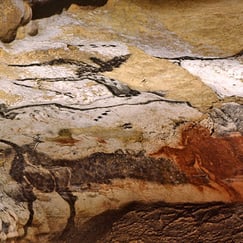
The art of prehistoric caves is epitomized by the majestic Hall of Bulls in Lascaux, where vast depictions of aurochs dominate. These ancient wild bulls, portrayed in imposing sizes, seem to lead a diverse herd of about thirty other species, including horses and deer, depicted in a frenzy of movement above ground level, forming an aerial animal parade.
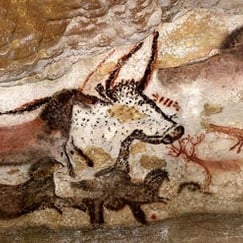
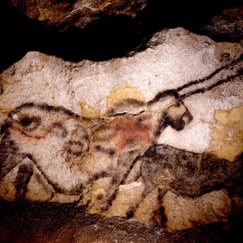
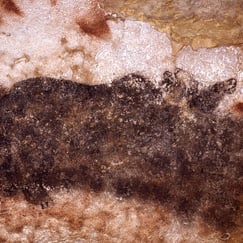
This iconic hall is divided into areas, each panel named after the creatures it features. The Unicorn Panel presents a mysterious, indistinct animal, speckled and adorned with two straight, long horns. Opposite, the Bear Panel reveals a bull whose dark outline partially covers the features of a bear, with only the ears and a claw distinctly emerging. This is the sole representation of a bear in Lascaux.
These frescoes embody the essence of the period’s wall art, dominated by a rich fauna while human figures and floral elements are almost nonexistent. The represented species reflect the surrounding fauna of prehistoric man, thus testifying to their predominant presence in his daily life.
Ingenious Hunters
The creators of the Lascaux frescoes were primarily itinerant hunters, skilled in the art of tracking and imbued with the rhythms of the wild. Hunting sharpened their observational skills, capturing the movement or stillness of animals, which they later depicted from memory. This accounts for some anatomical inaccuracies, such as the imprecise portrayal of aurochs’ hooves or the approximate outlines of horses.
To reach and paint the cave’s heights, these hunter-gatherers improvised ladders using sturdy tree branches. Their light sources were oil lamps and torches. As for the pigments needed for their wall art, they were extracted from the surrounding rocks: ochre for shades of red and yellow, and manganese oxides for black. These pigments were ground into powder, mixed with water, and then applied to the rock wall using brushes, pads, fingers, or blown through leather stencils or hands.
2. Masters of Shadow and Ochre: The Onset of Unprecedented Artistic Expertise
Accomplished Artists
The Lascaux cave painters went beyond simple sketching; their command over color is notably seen in the depiction of a red and black horse on the Unicorn Panel. They utilized the technique of reserve, leaving spaces unpainted to emphasize the form and volume of figures, thereby suggesting a perspective and three-dimensional depth.
Their artistic flair also included the integration of the cave’s natural features into their creations. The cave’s natural ledge was used to mimic the ground that the animals are depicted as walking on, while the rock’s protrusions were cleverly used to outline the hindquarters of an animal. This adept use of natural elements in their art shows a deep understanding and incorporation of their surroundings into prehistoric artistry.
1 - The Unicorn Panel 2 - The Unicorn Panel. 3 - A curious animal 4 - The Bear Panel
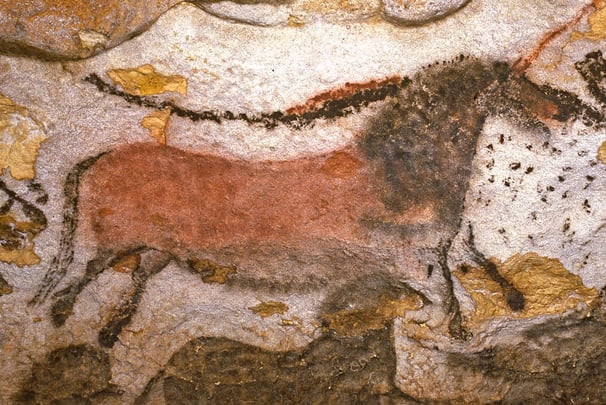
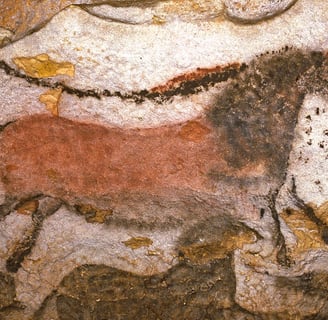
The red and black horse
Reserve: A technique in painting and sculpture that involves not working on the entire surface. The unworked part is left in reserve.
Perspective: A technique that enables the representation of space and objects with depth and volume on a flat surface to create the illusion of the third dimension.
A Sanctuary
Lascaux transcends being a mere prehistoric shelter; it functioned as a sanctuary, a place imbued with sacredness. The painted animals, central to the hunters’ existence of that era, weren’t just related to hunting practices or magical rites; indeed, while reindeer formed their primary diet, it is scarcely depicted in the cave paintings.
The precise meanings of Lascaux remain a puzzle, but one thing is clear: through art, Paleolithic humans found a mode of expression, a way to mark their presence and ensure their legacy. The frescoes of Lascaux move us because they forge a direct connection with our ancestors, highlighting the creative drive inherent in humankind.
Thus, Lascaux is often dubbed the Sistine Chapel of Prehistory, a title inspired by Fernand Windels’ 1948 publication, and resonating with the work of Henri Breuil, a prominent expert in cave art and the first prehistorian to examine the cave shortly after its rediscovery.
Sanctuary: A place or building consecrated to worship. The term can refer to different realities across religions. In ancient Greek world, it is a delimited space, sometimes very vast, dedicated to a deity and including the altar for sacrifices, the temple, and offerings. In Christianity, it specifically refers to the area of the church surrounding the high altar.
The works of Lascaux are not mere primitive expressions; they manifest refined artistic knowledge and a keen understanding of movement and form. They reflect an intimate and respectful relationship with the fauna that shared the world of our forebears.
The paintings of Lascaux connect us with the creative spirit of early humans and remind us that art, from its inception, has always been a powerful means of communication and emotional expression.
Come explore the art and mysteries of prehistory by diving into the captivating world of Lascaux. Rediscover the origins of human creativity and draw inspiration from the evocative power of the earliest artists.
#LascauxCave #PrehistoricArt #AnimalsOfLascaux #ArtHistory #PrehistoricDordogne #AncientPaintings #CulturalHeritage
