
The Colors of Revolution: Diving into the World of Fauvism in the 20th Century
Embark on a vivid journey to the heart of Fauvism, where traditional art rules dissolve in a whirlwind of pure and bold colors. Discover how, in the early 20th century, a group of daring artists redefined the boundaries of painting, giving birth to one of the most revolutionary and expressive movements in art history. From Matisse to Derain, dive into the fascinating story of Fauvism and feel the emotional intensity of each brushstroke.
Faluns of Anjou Arts
Welcome to our blog dedicated to lovers of French art history. Today, we dive into the vibrant world of the Fauves with the theme “The Fauves: Color Unleashed” in the 20th century. This revolutionary artistic period marked a major turning point, freeing color from its traditional conventions and paving the way for bold and emotional artistic expression.
How did the Fauvist movement transform the perception and use of color in art, and how did this chromatic liberation influence subsequent artistic trends of the 20th century?
I. Color Revolution: The Birth and Characteristics of the Fauves
Emergence of Fauvism, its Key Players, and Chromatic Techniques and Innovations
A. Fauvism, a Movement Initiated by Critics
The term "Fauvism" was coined by art critic Louis Vauxcelles during the 1905 Autumn Salon at the Grand Palais, where a room exhibiting innovative painters was named "The Fauves' Cage." This designation refers to the bold and unconventional use of colors by these artists. The public and media reception was predominantly negative and characterized by shock. Camille Mauclair from the newspaper Le Figaro likened the impact of the works to "a pot of paint thrown in the face of the public." Fauvism, a distinctly French movement, evolved around Henri Matisse, the leading figure of the group. His painting "Woman with a Hat" caused a particular stir due to its free composition and the use of vibrant, varied colors, especially in the depiction of the woman’s face.
B. Distinctive Features of Fauvism
Fauvism is marked by simplified drawing and bold use of color, often detached from reality. The brushstrokes are dynamic and visible, employing a palette of bright and saturated colors. Fauvist artists applied paint in distinct dabs or flat areas, opting for unblended colors to achieve maximum intensity. The contrasts between colors are striking, without subtle shades or gradients.
Subjects of Fauvism:
Fauvists predominantly focused on outdoor landscapes, moving away from the bourgeois interior representations typical of the Nabis. This preference for landscapes coincides with the period of 1906-1907, marked by extensive travels of the Fauvist artists. Key figures of the Fauvist movement include: Henri Matisse, Maurice de Vlaminck, André Derain.
II. The Fauves' Legacy and Their Influence on Modern Art
The Fauvism's impact on contemporary and later art movements. Color as a means of emotional and artistic expression.
A. Fauvism, Orchestrated by Matisse
Henri Matisse, a leading figure in Fauvism, was profoundly influenced by the summer of 1904 he spent with Paul Signac, from whom he learned the techniques of color division and Neo-Impressionism.
This experience greatly inspired Matisse, who in 1905 shared his new understanding of color with André Derain during a summer they spent together in Collioure, in the South of France.
A group of painters quickly formed around Matisse and Derain, including Henri Manguin, Charles Camoin, and Georges Braque. They all shared a common enthusiasm for the use of bright, pure colors.
In Fauvist art, the emphasis is placed on color rather than drawing or fidelity to reality. This approach profoundly influenced Henri Matisse for much of his career. Fauvist works are characterized by bright, unaltered colors intended to make a strong visual impact on the viewer. The Fauves abandoned traditional colors for surprising and vibrant shades, embracing a subjective view of reality far removed from any literal depiction. Their paintings tend toward a simplification of forms, and each Fauve painter has a distinct and unique pictorial style.
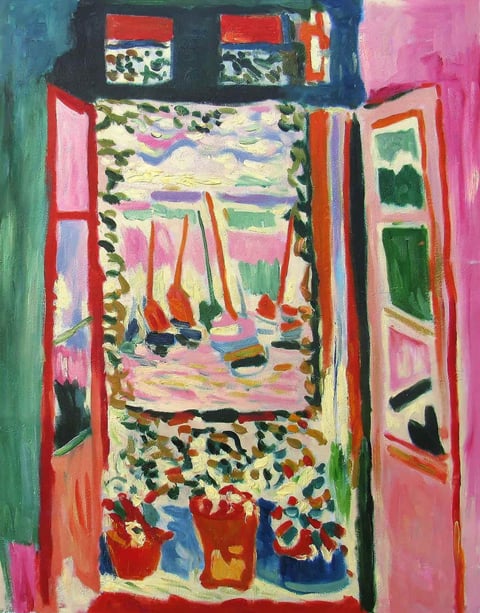
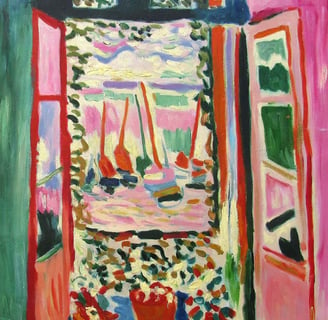
“The Open Window at Collioure,” Henri Matisse, 1905
B. Maurice de Vlaminck
Maurice de Vlaminck stands out as one of the most intense artists of the Fauvist movement. His works, easily recognizable by their use of pure colors, exude energy and raw power, as seen in his painting "Restaurant at La Machine at Bougival". Vlaminck had the habit of applying paint directly from the tube onto the canvas, a revolutionary method at that time. His "Restaurant at La Machine at Bougival" perfectly illustrates this spontaneous and bold approach to painting.
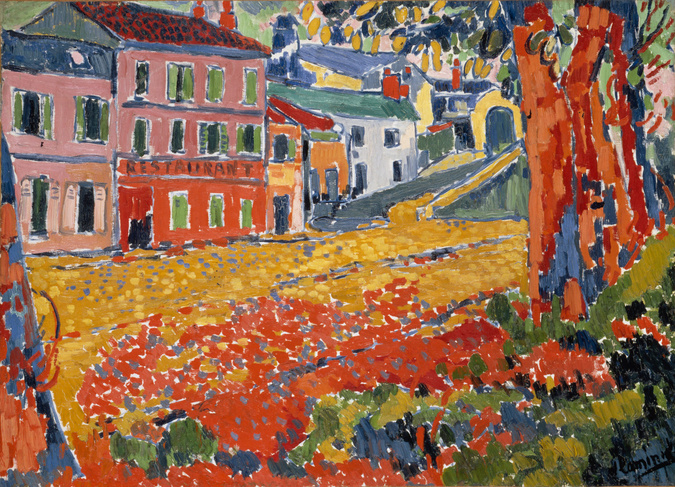
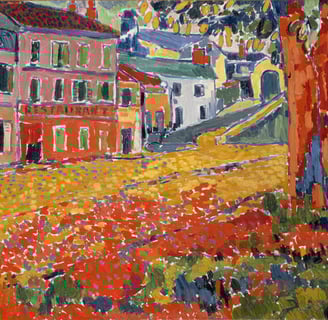
Restaurant de la Machine at Bougival, Maurice de Vlaminck, 1905
C. André Derain
During two stays in London, André Derain created the celebrated work "Charing Cross Bridge". In this painting, he uses flat areas of color to represent elements such as the roadway and buildings. The colors are applied unconventionally: the Thames appears yellow, while the curved road is painted green. This work was featured at the Autumn Salon in 1906.
D. Georges Braque
Before turning to Cubism, Georges Braque painted "The Gulf of Lecques". This canvas depicts a gulf surrounded by mountains and olive trees, treated in a style similar to that of Vlaminck and Derain. The painting consists of flat areas of color that form the various elements. Small touches reminiscent of the Impressionists and Pointillists are visible. The vivid color palette, mixing reds, purples, and greens, creates strong contrasts.
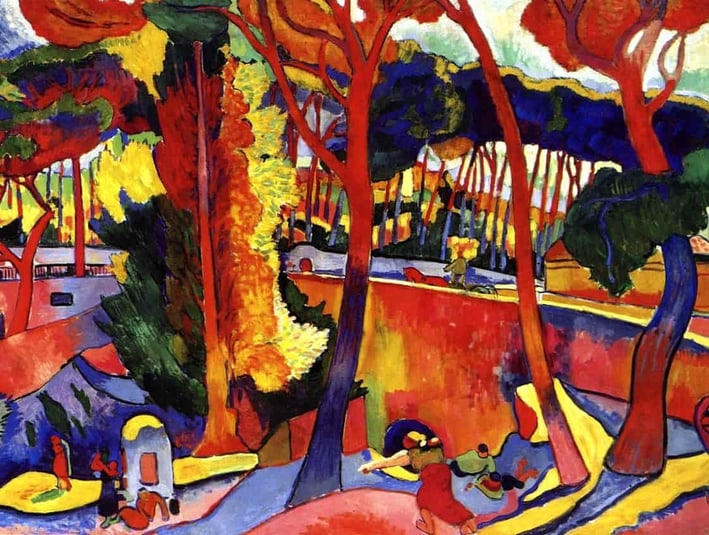
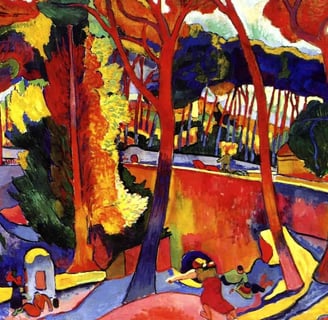
Turning Road at L'Estaque, André Derain, 1906
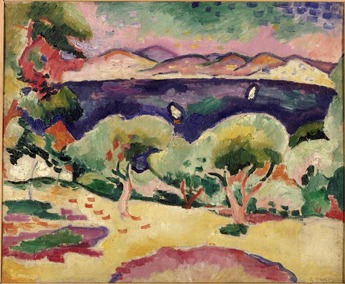
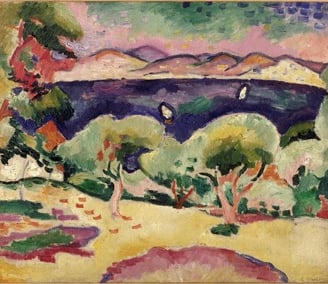
Georges Braque, The Gulf of Lecques, 1907, Oil on canvas, 38 x 46 cm. Paris, National Museum of Modern Art - Centre Georges Pompidou
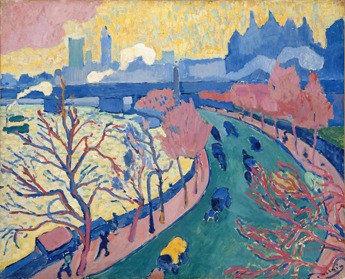
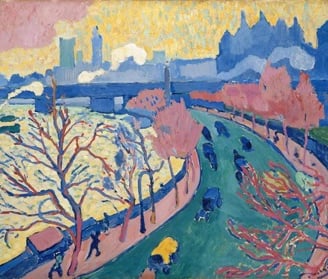
André Derain, Charing Cross Bridge, London, circa 1906, Oil on canvas, 81 x 100 cm. Vollard collection; Kaganovitch collection, Paris, Musée d’Orsay
Fauvism, known for its bold and innovative use of bright colors, broke away from tradition and redefined the boundaries of artistic expression. This period not only marked a turning point in the use of color but also laid the groundwork for the evolution of modern art.
The Fauves played a pivotal role in the history of 20th-century art, revolutionizing how color is perceived and utilized in art. Their legacy continues in modern artistic movements, attesting to the enduring impact of their innovative approach.
For all those passionate about the history of French art and its revolutionary movements, join us for a deeper exploration of the Fauves and their impact on modern art. Subscribe to our blog to not miss any of our exciting discoveries.
#ExplosiveFauvism, #ColorRevolution, #MasterfulMatisse, #20thCenturyArt, #BoldPalette, #FauvistPioneers, #InnovatorDerain
